Showing posts with label TM. Show all posts

Sunday, 2 March 2014

secular Buddhism 101: 'mudita' and the everyday sublime

 reverse applique felt, embroidery (using rainbow thread) and button mandala

Since becoming aware of Acceptance and Commitment Therapy (ACT) almost 4 years ago, when I attended my first Russ Harris workshop, I have also been discovering (and rediscovering) various forms of meditation and mindfulness practice.

I first learnt Transcendental Meditation (TM) when I was fifteen, thanks to my friend Susan, who suggested we attend a talk one evening after school at the Adult Education Centre in Dartington, South Devon. We went on to learn TM, which involves the repetition of a mantra (or sound), and focusing on the mantra instead of thoughts, which leads to a deep level of relaxation, and change in brain wave patterns, quite quickly. We practised regularly for a while, but being teenagers, we didn't like the feeling of being monitored by the teachers after the class - to be fair, they were only being supportive, but I was very rebellious.

 water soluble oil pastel Buddha face

I practiced TM intermittently since, but started to do so regularly again after seeing the value of mindfulness in my clinical practice, and also as a self-care tool, soon after learning about ACT. My teenage clients are fairly unimpressed with the idea of regular meditation, so I often talk about mindfulness in daily life, instead. This means noticing what your senses are telling you, rather than your thoughts.

I have just realised I have been doing TM incorrectly, after reading this article by Stuart Heritage, who points out that you are supposed to meditate twice a day for 20 minutes, whereas I have been doing it for 30 minutes once a day. So I am in a ten minute deficit, but no doubt some is a lot better than none.

I am also curious about the secrecy surrounding the mantra that Heritage refers to. The cynical part of me suspects this is a way of keeping the teachers as the experts, so new learners don't teach their friends - its a pretty simple technique. There was quite a ritual to the giving of the mantra, and it being specially chosen to suit our personality: however, when Susan and I eventually told each other our mantras (against instructions - but we were rebellious teenagers, what did they expect?) we realised we both had the same one, which was kind of deflating. Perhaps that is another reason for the secrecy...
 appliqued new and vintage textile labyrinth meditation path 
(which formed part of my social work frameworks presentation - social work is represented by the  embroidered tablecloth)

The idea of the labyrinth as a walking meditation path is an ancient one and occurs in a variety of cultures including christianity. I became aware of the potential of the finger labyrinth as a meditation tool through one of my students, also an ACT afficionado, who conducted a pilot  research project into using finger labyrinths.Basically the finger traces the path, which resembles a walking meditation path, but is obviously much smaller.
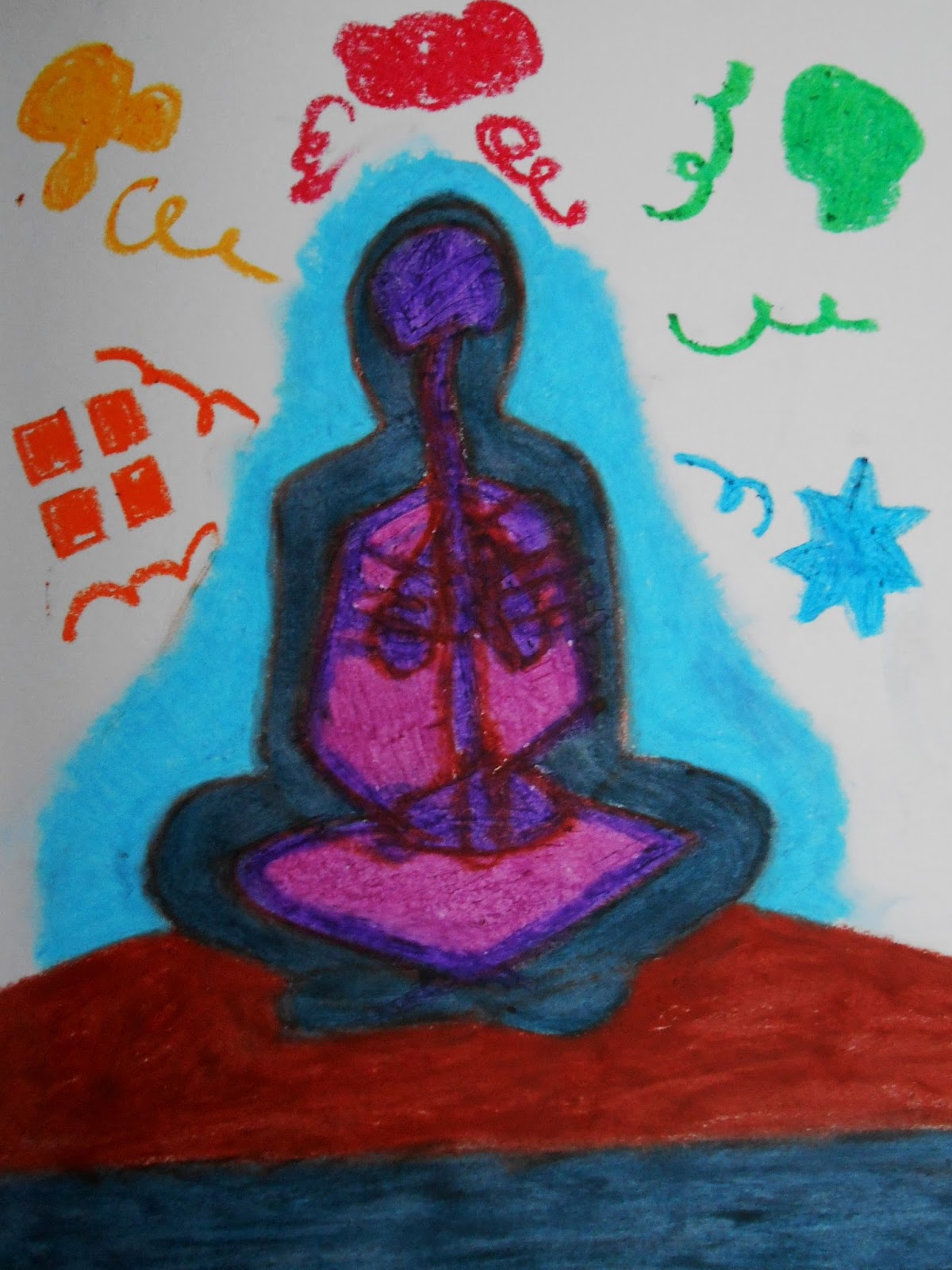
sitting meditation - pastels

This weekend I attended talks by Martine and Stephen Batchelor, who teach within the Buddhist tradition, but from a secular and contemporary perspective. The talks included walking and sitting meditations, with a focus on developing 'mudita', or Appreciative Joy, which is one of the four virtues/divine states of dwelling or 'feeling tones' as Martine described them. The other three are Loving Kindness (metta), Compassion (karuna) and Equanimity (upekkha).

Stephen then talked later about the Everyday Sublime, (he also said to be very wary of any nouns beginning with capital letters, but anyway). This equates to mindfulness in everyday life, and includes appreciative joy, but also suffering, which Buddhism is often concerned with. This all fits very neatly with ACT, which emphasises the human tendency towards'experiential avoidance', or how we try to avoid feeling anything we label bad, sad or mad.

The main point of Stephen's talk was the role of the arts and the artist in practicing the Four Noble Tasks (often called Truths, but he prefers Tasks, which is also very ACT-ish, as it emphasises action). The sublime is a term from aesthetics, which includes terrifying yet fascinating experiences and the emotions they evoke, as identified by the Romantic poets, for example. Stephen suggests the role of the artist is to articulate the everyday sublime, and this includes:
  • Embracing Life
  • Letting go of Reactivity
  • Affirming Freedom from Reactivity and 
  • Cultivating this way of life, 
which together leads to Awakening or Enlightenment (more capital letters).

All very interesting and I feel very inadequate in trying to relay the concepts, but I am hoping this will help me remember and understand, as much as anything. This is quite a long post, and now I am going out to dinner. It was my (our) wedding Uni-versary (we got married on Leap Year Day) this weekend.

Congratulations if you made it this far, which is also a good thought for an anniversary, albeit not a 'real' one.. embracing the everyday sublime, appreciating the joy, and the wisdom to know the difference, or something.

more later

Thursday, 31 May 2012

Rainbow on Mater Hill


'rainbow on Mater Hill' using Polaroid app.

Last night a rainbow appeared over the Hotel Diana opposite the Mater Hospital, as I arrived to view my art therapy students' case study presentations. Its the end of semester, which means no more assignment writing (for me - hurrah!) but lots of marking activities in the next few weeks. I have now completed (as long as I pass all my assignments) a quarter of my Masters of Social Work. 

Do rainbows really appear at symbolic times, or do we just notice them more at significant moments? I remember seeing one just after my father died, in March 2010, and at the time I found this very comforting. 


'mantra' - pastels and dyetex

This drawing is about meditation, and reflects how the mantra (sound) which I repeat in my mind when I meditate (using the Transcendental Meditation, or TM method) becomes overridden with thoughts. The mantra is represented by the letter 'i' (the mantra starts with the letter 'i') and is in pink, faintly visible inside the white shapes. Meanwhile, thoughts crowd in, and overlay the mantra. Some of them follow pathways, represented by the wiggly lines, and some are more random, represented by colours. The overall effect, although distracted from the intention, is still positive.

Visually, this image appeals to me: it creates the effect of a colour field, which besides being an art movement, also makes me think of the Tamla Motown and Phil Spector's 'wall of sound'. The element of cohesion, and the submersion of individual parts into the overall image, seem to fit with this style of composition (whether music or art). Interesting, since I started this by writing about the sound of the mantra. 

'yarn-bomb' on riverside bikeway near QUT, using Polaroid app.

I spotted this piece of knitted 'graffitti' whilst cycling a few weeks ago, but only just stopped to photograph it. The link above is to a site which details a collective yarn-bombing of King George's Square in Brisbane, tomorrow. Amazing what a google can unearth.

Meanwhile, I am still knitting a jumper I started last year. (As it is sleeveless, it is possible I may complete it this year, while its still cold enough to wear it. I made the mistake of putting it in my handbag the other day, and lost some stitches, and I picked them up slightly incorrectly, so its now flawed, but I don't think it will matter...) 

The middle of 'Caution': location of yarn bomb and bicycle

During the break between semesters, I am hoping to post more often. We'll see how that goes. 

succulent, South Bank, using Pin hole app.


more later.